Bnder · Aug 3, 2026
Best Help Desk Tools That Connect Support Tickets to Product Tasks
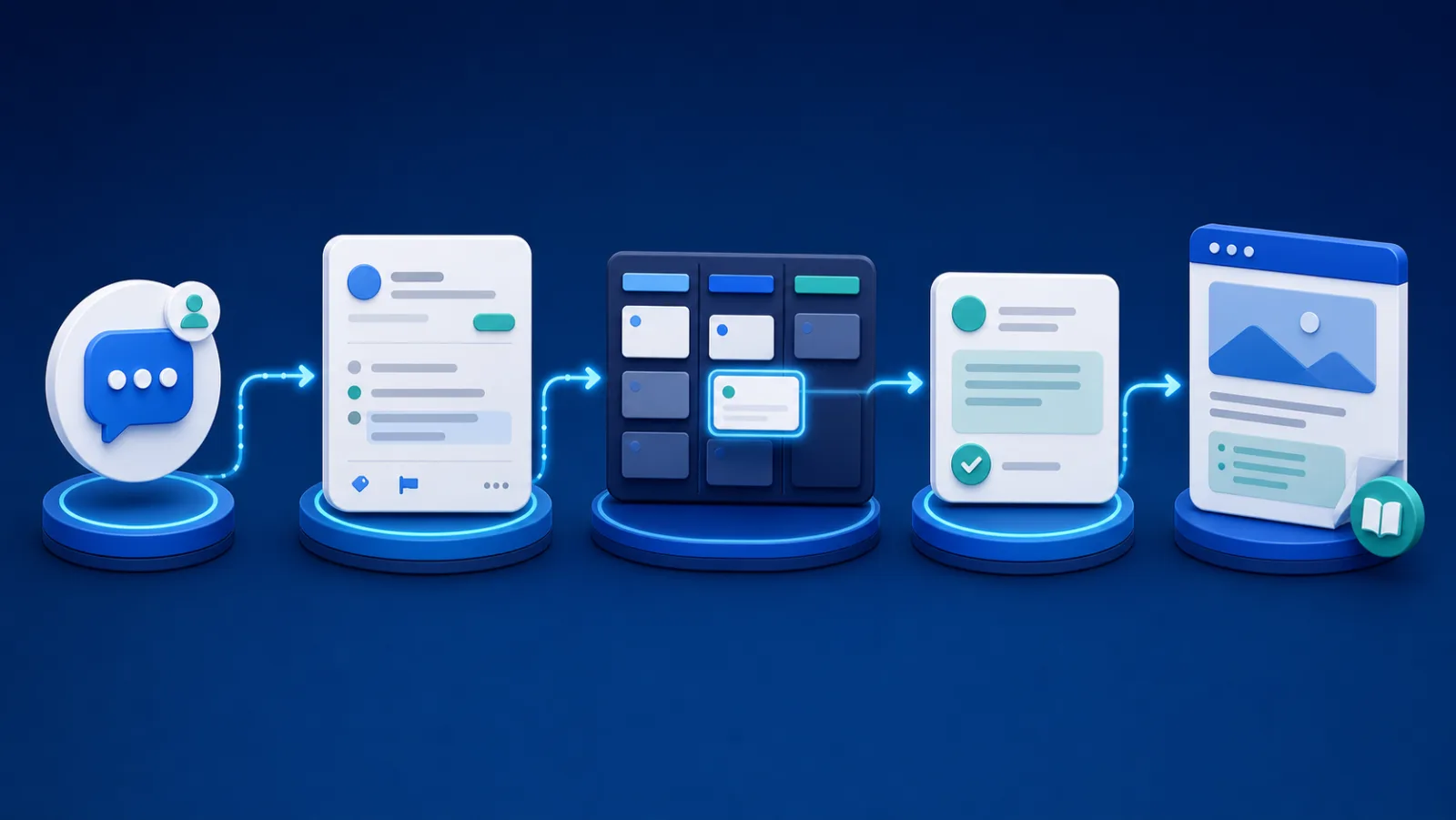
AI-generated illustration.
The handoff from support to product is where valuable context disappears. A support agent summarizes the request in an issue tracker, engineering asks for reproduction details already present in the conversation, and the customer receives no update when the work is finished.
This comparison focuses narrowly on that boundary. Bnder publishes it and ranks well because connected support and product work is its core use case. The other tools may be better when their broader specialties match your organization. Our review methodology explains that weighting and disclosure.
Ticket-to-task approaches compared
| Product or stack | Connection model | Best fit |
|---|---|---|
| Bnder | Native linked ticket and task | One small support-and-product team |
| Intercom | Back-office and tracker tickets | Messaging-led support |
| Jira Service Management | Jira-native service and development work | Atlassian organizations |
| Help Scout plus Linear or Jira | Support-to-tracker integration | Teams keeping specialist tools |
| Zendesk plus a tracker | Marketplace or API integration | Mature Zendesk operations |
| Linear Customer Requests | Product-side evidence layer | Linear-centered delivery |
Evaluation criteria
We look for five capabilities:
- Create product work without retyping the request.
- Preserve a link to the original customer and conversation.
- Let product and support have different owners and statuses.
- Group multiple affected customers around one underlying issue.
- Return the resolution to the support workflow.
Bnder: one workspace for the full loop
Bnder keeps a ticket and its linked task as separate but connected records. The product team can plan delivery while support retains the customer-facing thread. Solved issues can feed a public help center, giving the next customer a durable answer.
This reduces integration work for small SaaS teams. Organizations that require a specialized enterprise help desk and a deeply customized engineering platform may prefer two products.
Intercom: tracker tickets for shared customer issues
Intercom supports customer tickets, back-office tickets, and tracker tickets. Tracker tickets are designed to group conversations affected by a common bug, interruption, or request and broadcast updates. Intercom is especially relevant when those reports begin in Messenger or its omnichannel Inbox.
Jira Service Management: service and development on Atlassian
Jira Service Management connects request, incident, problem, and change workflows with Jira's development platform. It is powerful for organizations already using Atlassian and for operationally mature teams. Configuration and ITSM concepts can be more than a small customer-support team needs.
Help Scout with Linear or Jira
Help Scout offers integrations that can create and link issues in Linear or Jira from a conversation. This is a sensible model when support values Help Scout's inbox and engineering will not leave its tracker. During a trial, verify how assignee, status, comments, and completion flow between systems.
Zendesk with marketplace integrations
Zendesk can connect its ticketing suite to many development tools through its marketplace and APIs. It works best when Zendesk is already justified by channel breadth, reporting, and support operations. The product-task bridge remains an integration boundary that someone must monitor.
Linear Customer Requests
Linear Customer Requests brings customer evidence into product development and accepts requests from support tools, email, CRM systems, and shared Slack channels. It is product-first rather than a complete customer help desk, making it a good counterpart to an inbox but not necessarily a replacement for one.
The practical choice
Use Bnder when one small team owns both sides and wants the shortest path from ticket to task to documentation. Use Intercom when customer messaging and grouped issue updates are central. Use Jira Service Management for formal Atlassian-based service workflows. Keep Help Scout or Zendesk connected to a specialist tracker when each department needs its own mature system. Use Linear Customer Requests when product discovery is the primary problem.
Whatever you choose, measure one number after rollout: how many customer-impacting product tasks close without a customer update? A technically successful integration that still leaves customers waiting has not solved the handoff.
Frequently asked questions
How should duplicate support tickets connect to one product task?
Each ticket should retain its own customer conversation while linking to the shared underlying task. Product priority can then consider the number and value of affected customers without creating duplicate engineering work. Resolution should produce a follow-up action for every linked request.
Should engineers work directly in the help desk?
Only when its internal task model supports the planning and development context they need. Otherwise keep engineers in their tracker and make the integration reliable. Forcing every engineer into a support seat can be more expensive and less usable than maintaining one well-owned boundary.